Head to head
AirTag vs GPS dog tracker: what UK dog owners actually need
The AirTag vs GPS dog tracker question comes down to one fact most listings gloss over: an Apple AirTag contains no GPS at all. At £29 it is a tempting alternative to a tracker with a monthly plan, and in the right setting it genuinely helps. In the wrong one it goes silent exactly when your dog is moving fastest. Here is the honest UK picture, with prices checked on 29 August 2026.
The short answer
An AirTag and a GPS tracker solve different problems. The AirTag answers "where did I last leave this?". A GPS tracker answers "where is my dog right now, and which way is he heading?". For a dog, the second question is usually the one that matters, which is why every device on our best dog GPS trackers list has a GPS chip and a SIM, and the AirTag is not on it.
That said, the AirTag earns its £29 in two situations: as a silent, subscription free backup alongside a proper tracker, and as the only practical option for toy breeds that cannot carry a 30 to 40 g GPS unit. We explain both below.
One honesty note. We have not yet bench tested an AirTag on a dog. Everything here about the AirTag is verified from Apple's official pages as of 29 August 2026. The GPS side draws on the two trackers on our bench, the Tractive DOG 6 and the Pawfit 3s, whose structured test cycle is still running.
How an AirTag finds things, and why that matters for dogs
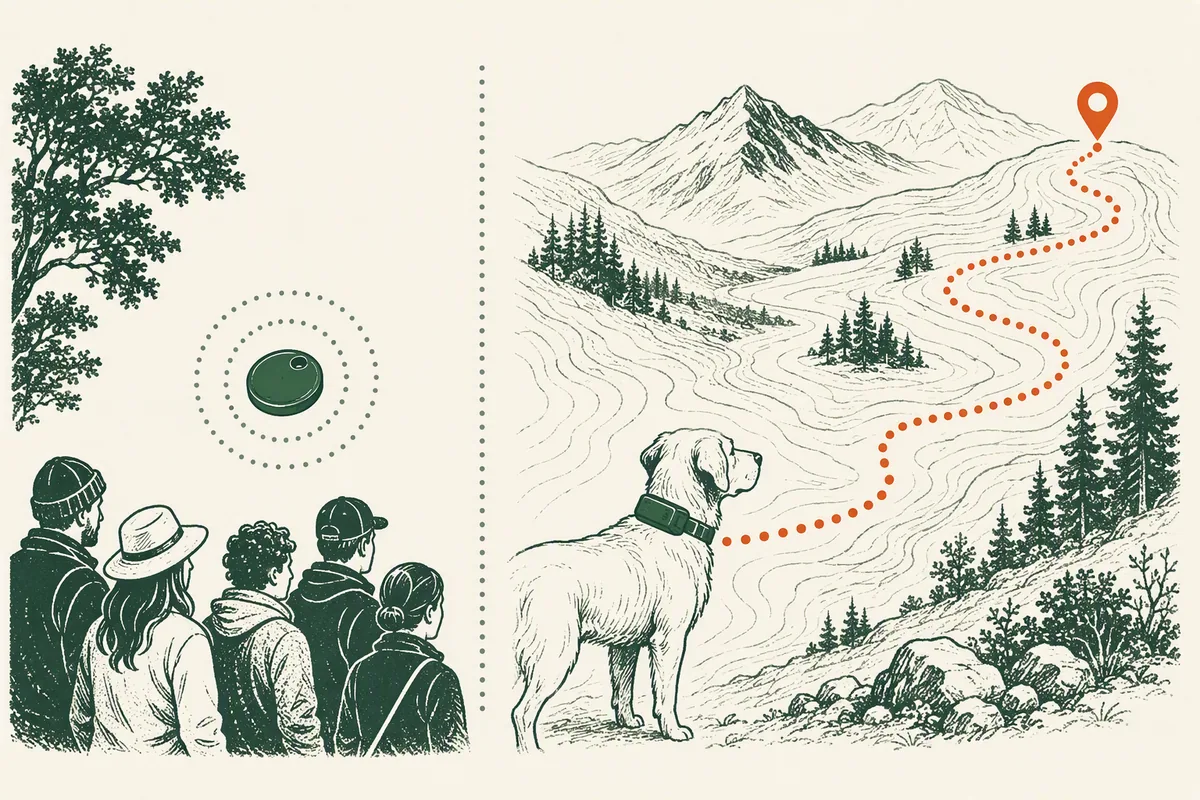
An AirTag is a Bluetooth beacon, not a tracker. It broadcasts a short range signal, and any nearby iPhone, iPad or Mac that hears it quietly relays that device's own location to Apple's Find My network. You then see the AirTag on a map at the spot where it was last overheard.
Three consequences follow for dog owners:
- Updates depend entirely on passers-by. No Apple device within Bluetooth range means no update. A dog in a hedgerow half a mile from the footpath can sit at "last seen 40 minutes ago" indefinitely.
- There is no live mode. You cannot watch your dog move across a map, so you cannot tell which way a running dog is heading. You get breadcrumbs. Minutes or hours apart, always pointing to the past.
- It is Apple only. Setup and tracking need an iPhone or iPad. Android owners cannot use an AirTag as a finder at all.
Precision Finding on recent iPhones is genuinely clever for the final few metres, steering you by arrow to the tag, but it only starts once you are already close. Useful for a tag slipped under a shed. Irrelevant while the dog is still moving.
What a real GPS tracker does differently
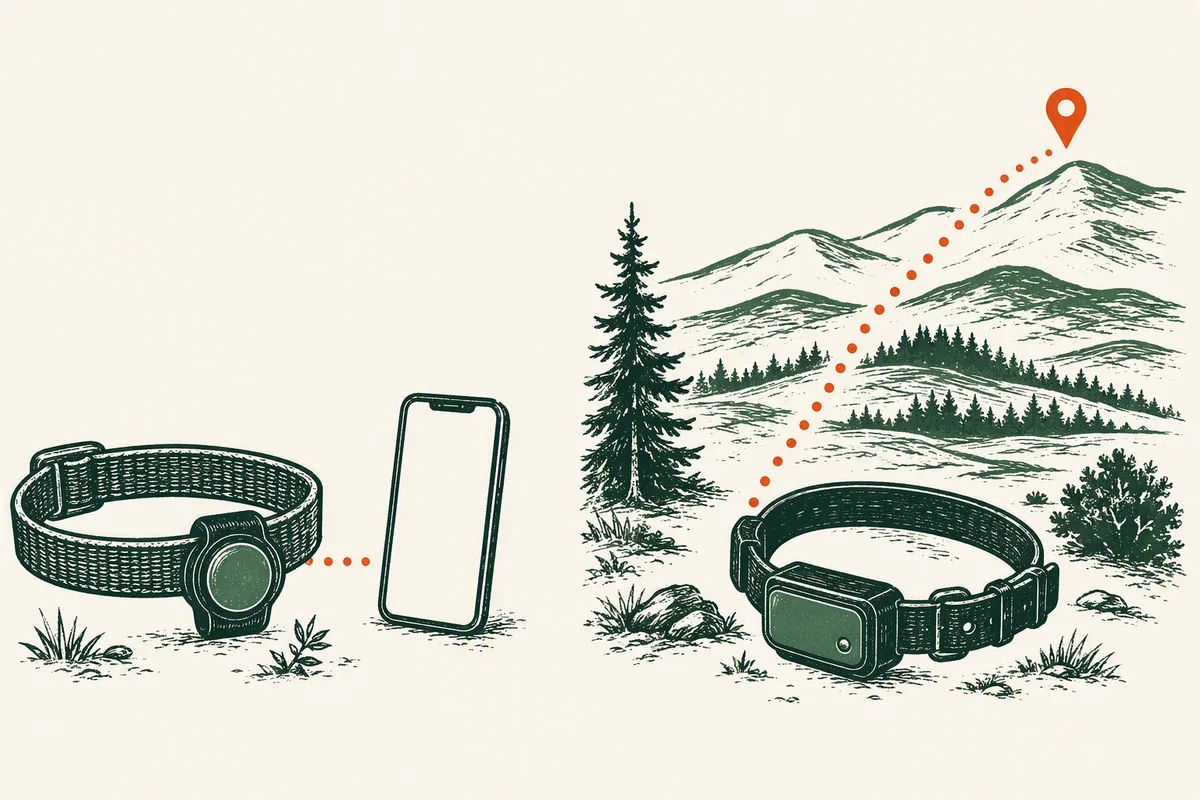
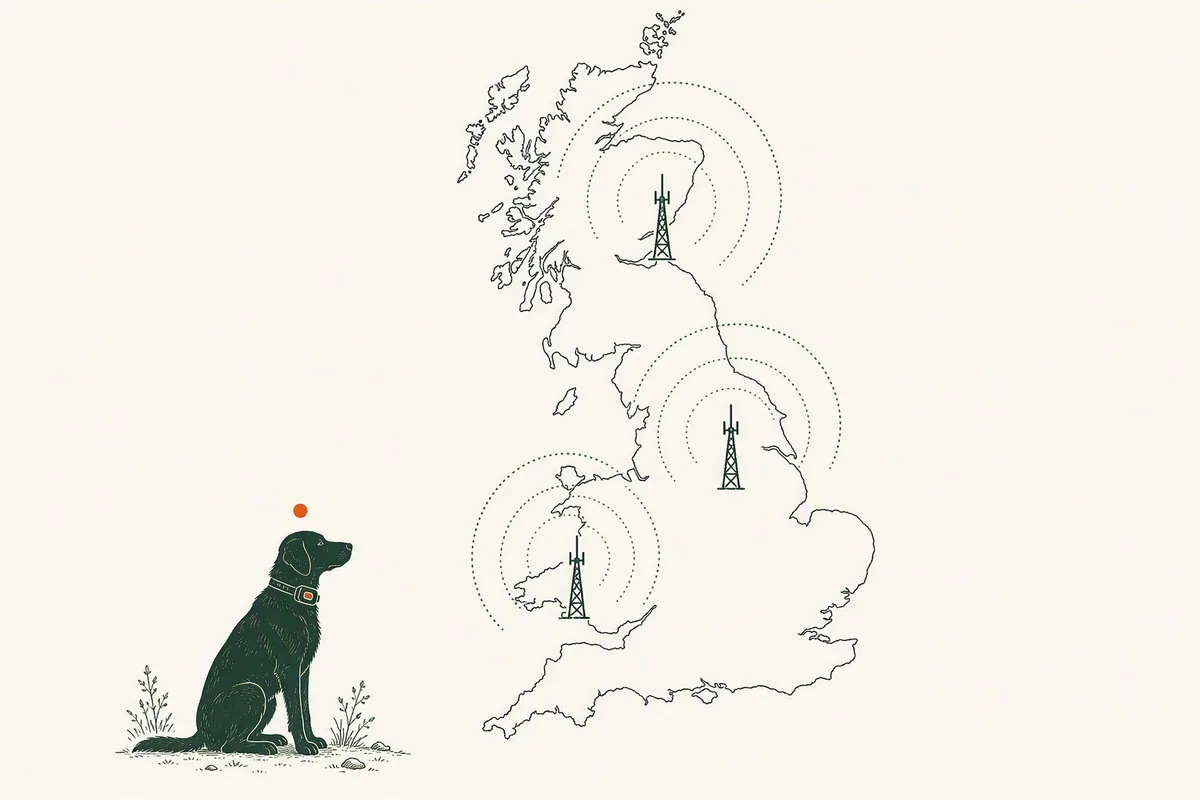
A GPS dog tracker carries a satellite receiver and its own SIM. It works out its position from GPS satellites and sends it to your phone over the mobile network. No passers-by required. That buys you the three things the AirTag cannot do: a live moving dot during a chase, position updates in empty countryside, and escape alerts when your dog leaves a virtual fence you have drawn. The mechanics are in our plain English explainer on how dog GPS trackers work.
The trade offs are real too. GPS trackers are heavier (the Tractive DOG 6 is a claimed 39 g against the AirTag's 11.8 g), they need charging every few days rather than a yearly battery swap, and almost all of them carry a subscription because someone has to pay for the SIM. The honourable exception is PitPat's £149 tracker with no monthly fees, covered in our PitPat GPS review.
Are AirTags safe for dogs?
Mostly yes. Two caveats are worth taking seriously.
Apple did not design it for pets. Apple has never marketed the AirTag as a pet tracker, and said at its 2021 launch that it was designed to track items, not pets or children. Apple sells no collar accessory of its own. The holders you see are third party, and quality varies a lot. If you use one, pick a holder that fully encloses the tag so it cannot be chewed out.
The battery is the real hazard. Inside is a user replaceable CR2032 lithium coin cell. Swallowed coin cells cause serious internal burns. A dog that chews out and swallows an AirTag is a same day veterinary emergency. Apple's UK support page (checked 29 August 2026) suggests using a bitterant coated CR2032 such as a Duracell 2032, while warning that some bitterant coatings might not work with AirTag. Test yours after fitting.
On the physical side the numbers are reassuring: 11.8 g adds nothing meaningful to any collar, and the IP67 rating (1 metre of water for up to 30 minutes) survives rain and puddles, though it is a notch below the IP68 claimed by the Tractive and Pawfit units, so think twice for dogs that swim.

Cost comparison: AirTag against the GPS field
| Device | Hardware | Running cost | Three year total |
|---|---|---|---|
| Apple AirTag | £29 (4 pack £99) | None; CR2032 battery swaps | About £35 with spare batteries |
| PitPat GPS | £149 | No monthly fees (PitPat pays the SIM data) | £149 |
| Pawfit 3 | £54.99 | Basic from £3.39/mo (long term) | £177.03 |
| Tractive DOG 6 | £59 (official eBay UK shop) | Basic €84/yr (1 year plan) | £59 + €252 |
On price alone the AirTag wins by a street, which is exactly why the question gets asked. The gap narrows if subscriptions are the objection rather than hardware cost: our no subscription dog trackers guide covers the middle ground, including PitPat's current £30 off code running until 31 August 2026.
When an AirTag is enough, and when it is not
An AirTag is a reasonable choice when:
- You live in a town or city, where passing iPhones update the location every few minutes on busy streets.
- Your dog is rarely off lead and you mainly fear a slipped collar or an opened gate, a "last seen outside the Co-op" problem.
- Your dog is a toy breed that genuinely cannot carry a 39 g GPS unit. At 11.8 g it is the lightest option on the market that does anything at all.
- You want a cheap, silent backup on the same collar as a GPS tracker.
It is the wrong tool when:
- You walk in rural Britain. Fields, fells, woodland and beaches out of season have almost no passing Apple devices, so updates can stop for hours.
- Your dog bolts. Without live tracking you cannot see direction of travel, which is the single most useful thing in the first ten minutes. Our lost dog guide explains why those minutes matter.
- Theft is the worry. iPhones warn people when an unknown AirTag travels with them and the tag can be made to chirp, so a thief with an iPhone is likely to find and bin it quickly.
- You use Android. There is no Find My access on Android, only detection apps.
What is on our bench, and what is not
We test on our own dogs before we score anything, and the AirTag has not had that treatment yet. Its specifications and prices above come from Apple's official UK pages, checked 29 August 2026. The GPS behaviour described here reflects daily life with the Tractive DOG 6 and Pawfit 3s, our two bench devices, while their structured test cycle runs.
Questions owners actually ask
Are AirTags safe for dogs?
AirTags are reasonably safe on a dog if fully enclosed in a secure collar holder, but Apple designed the device for items, not pets. The main danger is chewing and swallowing: the CR2032 coin cell inside is a veterinary emergency if ingested. Apple suggests bitterant coated batteries, though some may not work with AirTag.
Is an AirTag good for tracking a dog?
An AirTag is a decent backup but a poor primary dog tracker. It has no GPS chip: it only reports a location when someone's Apple device passes within Bluetooth range. In a town that can work well. In rural Britain updates can stop for hours, exactly when your dog is moving fastest.
How much is an AirTag in the UK?
An AirTag costs £29 from Apple UK, or £99 for a four pack, checked 29 August 2026. There is no subscription, and the user replaceable CR2032 battery costs a couple of pounds. A true GPS tracker costs more overall: typically £40 to £60 for hardware plus £3 to £13 a month.
Do AirTags work with Android phones?
AirTags do not work with Android for tracking. Apple's Find My network and AirTag pairing are Apple only, so you need an iPhone or iPad to set up and locate one. Android owners should choose a GPS tracker such as Tractive or Pawfit instead, both of which have full Android apps.
Can I use an AirTag and a GPS tracker together?
Yes, an AirTag plus a GPS tracker is a sensible belt and braces setup for medium and large dogs. The AirTag adds a silent, subscription free backup at just 11.8 g, while the GPS tracker does the live work. On toy breeds, though, the combined weight and bulk on one collar becomes unreasonable.