Emergency guide
How to Find a Lost Dog: The UK Playbook
A lost dog in the UK is not a private emergency, and it helps to know that before panic sets in. There is a free national database with volunteers on the ground, a legal duty on every council to deal with strays, a microchip register that vets and wardens check by default, and since August 2024 a specific criminal offence for anyone who takes or keeps your dog. This guide puts those channels in the order that gets dogs home, plus the exact first steps if your dog wears a GPS tracker. UK facts checked 29 August 2026.
The first hour: search systematically, not frantically
The instinct is to run in the direction the dog went, shouting its name. Resist it. The first hour rewards method, not mileage.
Fix the last seen point. That spot, not your best guess about where the dog is now, anchors everything. One person stays there for the whole search with a scent anchor: an unwashed jumper, the dog's blanket, its bed if home is close. Lost dogs often loop back, and a familiar smell plus a familiar person gives the loop a destination.
Search in widening circles from that point. Two or three searchers at most to begin with, heading in opposite directions with phones on. A crowd sweeps a nervous dog ahead of it. Check under and into things, not just along paths: gardens, outbuildings, ditches, hedgelines, the route back to the house or car.
Call briefly, then listen. Say the name once or twice, rattle a treat tin or the lead clip, then stand still for thirty seconds. Continuous shouting from several people reads as pursuit to a frightened dog and pushes it further out.
If the first hour becomes the first evening, come back at dusk and dawn. Roads and parks go quiet, and lost dogs move most when the world does not. Leave the scent anchor and a bowl of water out overnight where the dog was last seen.
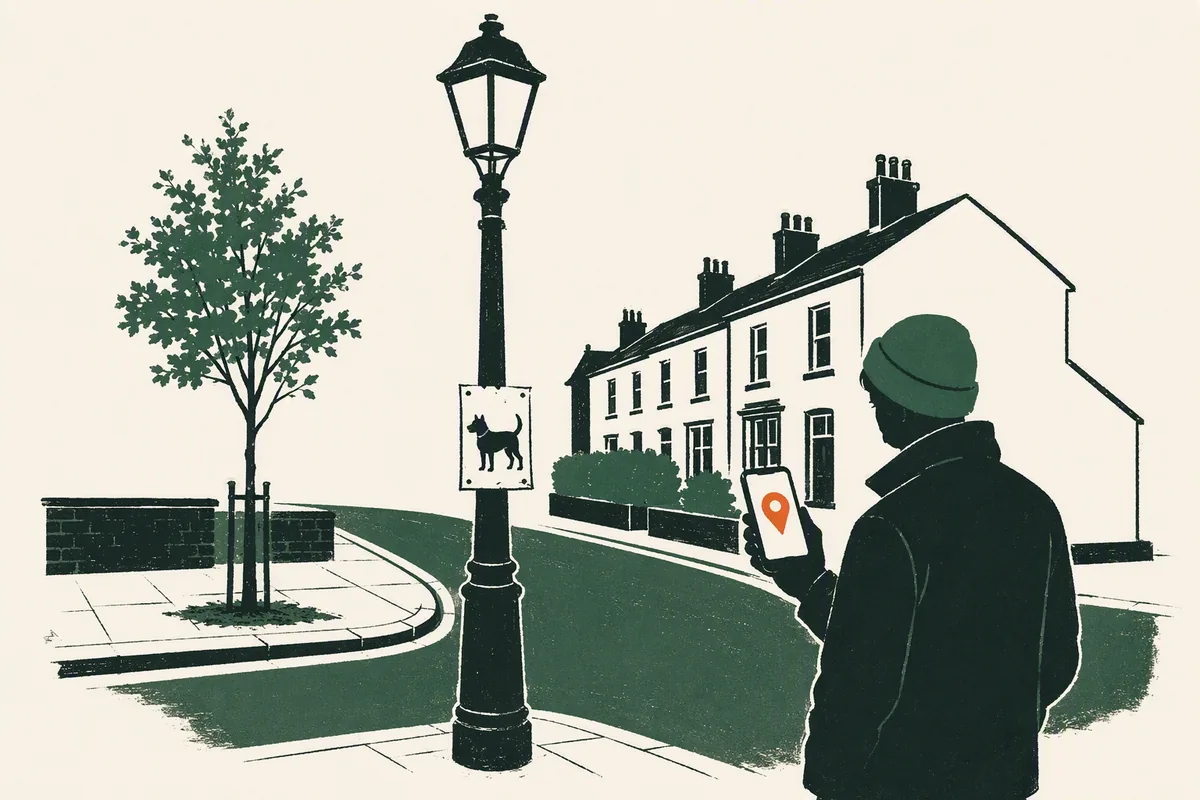
Report it: the UK channels that actually matter
While people search, one person with a phone does the reporting. The order below is the order of payoff.
1. Your microchip database. Flag the dog as lost so that any vet, dog warden or rescue that scans the chip rings you within minutes. Microchipping has been compulsory in England since 6 April 2016, with similar rules in Scotland and Wales, and the record must be kept current: the fine for out of date details runs up to £500. If you cannot remember which database holds your dog, the gov.uk list of compliant databases ran to 25 entries when we checked on 29 August 2026, including Petlog, Identibase and Animal Tracker, and a chip number lookup will point you to the right one.
2. DogLost.co.uk. Free, volunteer run since 2003, and still the closest thing the UK has to a national lost dog network. Registering creates a page for your dog, a printable poster and email alerts to helpers around your postcode. It costs nothing; ignore any lookalike service that asks for payment.
3. The council dog warden. This is a statutory role, not a favour. Section 149 of the Environmental Protection Act 1990 requires every local authority to appoint an officer to deal with stray dogs. If your dog is picked up, it is held for seven clear days, after which it can lawfully be rehomed or put to sleep, so ring on day one. Reclaiming means paying kennelling costs plus a prescribed fee, set at £25 by the 1992 stray dog regulations. Dogs do not respect council boundaries, so call the neighbouring authorities too.
4. Local vets, rescues and kennels. Anyone who finds a dog tends to walk it into the nearest surgery. Leave a description, a photo and two phone numbers.
| Channel | What it does | Cost |
|---|---|---|
| DogLost.co.uk | Free page, printable poster, alerts to volunteers near your postcode | Free, donation funded |
| Your microchip database | Flags the chip so any scan triggers a call to you | Free to flag as lost on the major databases |
| Council dog warden | Statutory stray service, holds seized dogs for seven clear days | Reclaim fee plus kennelling if the dog is picked up |
| Local vets and rescues | First stop for most finders, leave photo and numbers | Free |
| Police on 101 | Theft cases only, issues the crime reference number | Free |
When it is theft: 101 and a crime reference number
Some disappearances do not look like a dog wandering off. Gone from a secure garden, a cut lead or line, a van seen loitering, a GPS tracker found dumped by the gate: treat these as theft from the first phone call.
The law caught up in 2024. The Pet Abduction Act 2024 came into force in England and Northern Ireland on 24 August 2024 and makes taking or detaining someone's dog a specific criminal offence carrying up to five years in prison. In Scotland and Wales, dog theft is still prosecuted under existing theft law.
Call 101, or 999 if it is happening in front of you, describe the evidence and ask explicitly for a crime reference number. Without one, insurers stall, microchip databases cannot mark the dog as stolen, and follow up calls go nowhere. Our dog theft in the UK guide covers prevention and hotspots, and we have looked separately at whether GPS trackers actually stop theft.
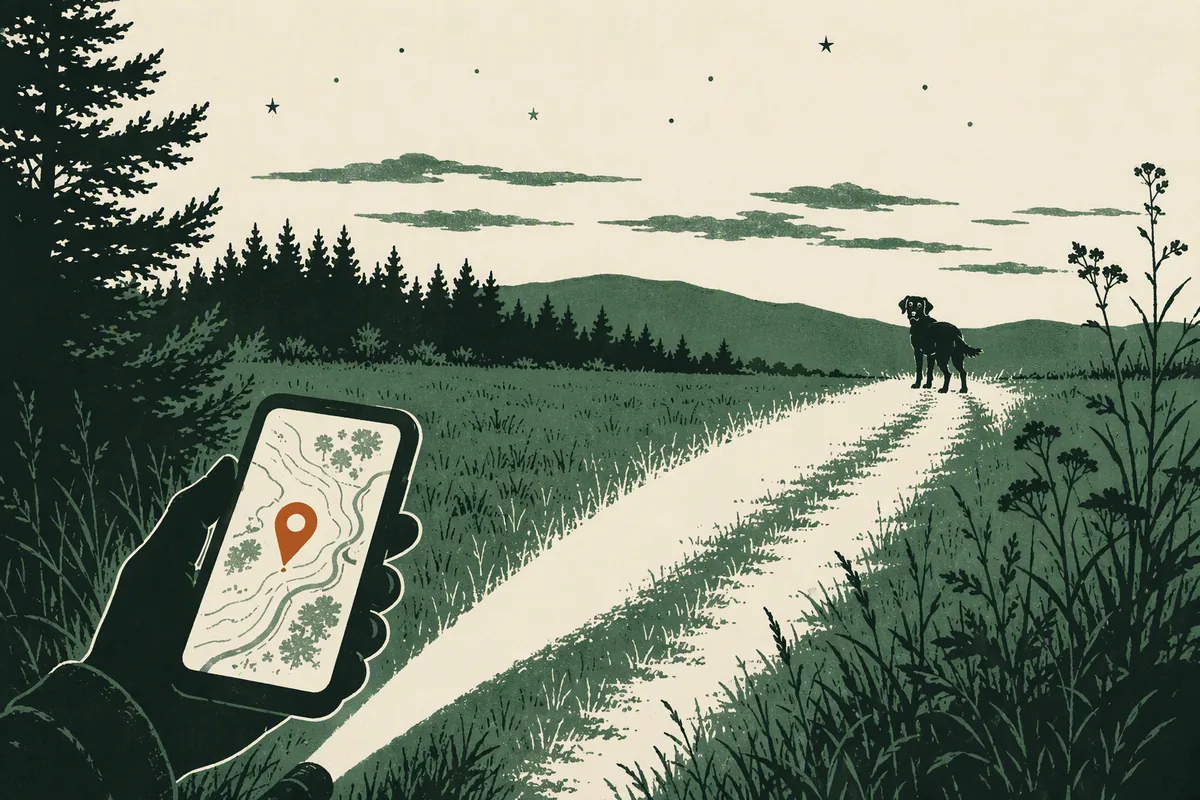
Do not chase: handling a dog in survival mode
A dog that has been lost and frightened for more than a few hours can drop into what behaviourists call survival mode. Friendly, well trained dogs in this state bolt from their own owners, and every chase teaches them that humans mean pursuit.
When you sight the dog, stop. Turn side on, avoid eye contact, and get low: sit or even lie on the ground. Scatter strong smelling food, chicken, hot dogs, tripe, in an arc towards you and talk quietly or not at all. Let the dog close the distance. Never grab at a collar; a missed grab can cost you days.
If the dog is holding a rough area but will not approach, switch from searching to settling. Set up a feeding station, refresh it at the same times daily, and keep foot traffic away. A calm, familiar dog brought to the area can draw a nervous one in. And make sure every poster and post repeats the same instruction to the public: report sightings, do not call the dog, do not chase.
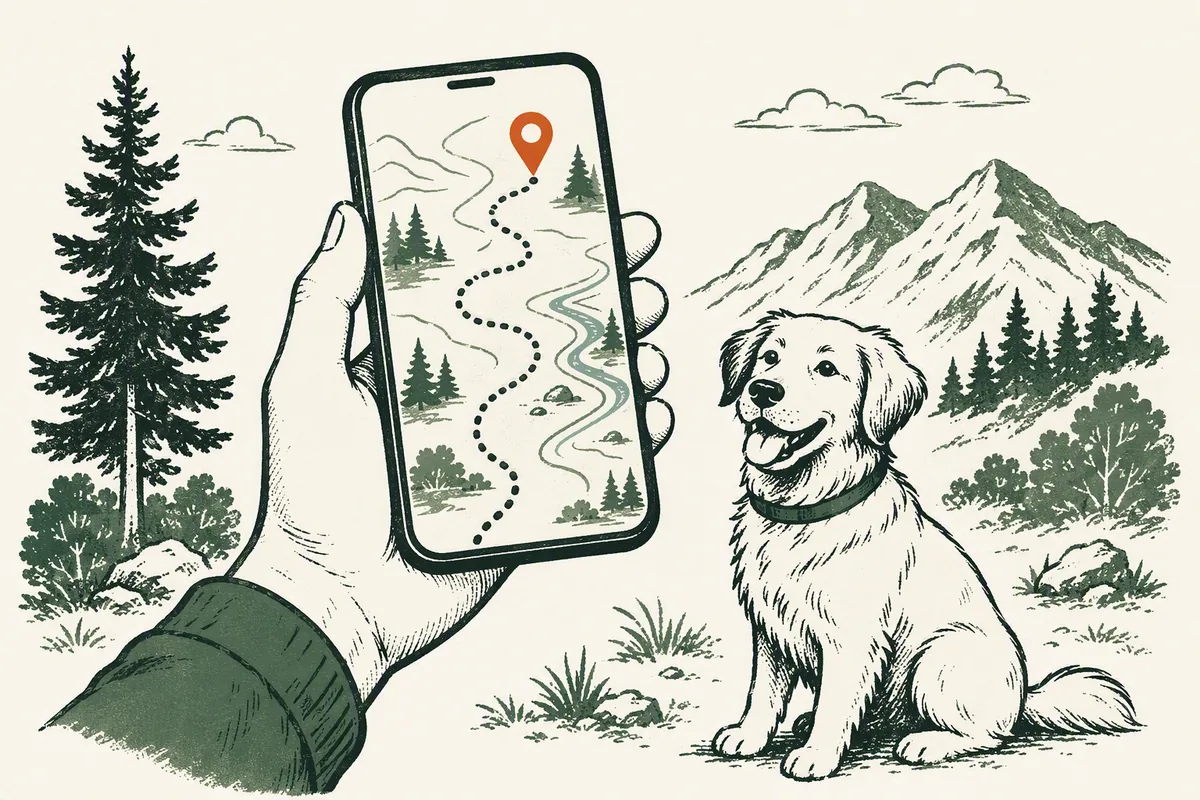
If your dog wears a GPS tracker: the exact first steps
A tracker changes the job from a search to a journey, but only if you use the first minutes well. This is the sequence we would follow with the two trackers on our bench, the Tractive DOG 6 and the Pawfit 3s. It applies to any cellular tracker.
- Switch to live mode immediately. Tractive calls it LIVE, Pawfit calls it live tracking; both replace the periodic position updates with a refresh every few seconds. These trackers work over the mobile network, so distance is not the problem. Battery is, which is point five.
- Read direction, not position. A single fix can be tens of metres out. Watch the trail for a minute or two and work out the line of travel, then aim to get ahead of the dog rather than behind it.
- Share the live location. Tractive can share a live tracking link, and Pawfit lets additional family members follow the tracker from their own phones. Put the map in the hands of whoever is driving so nobody is relaying grid references by phone.
- Pull the geofence and history before leaving the house. The geofence exit alert timestamps exactly when your dog left the safe zone, and the location history draws the route taken since. That gives you a search axis that survives even if the battery later dies.
- Manage the battery like fuel. Live mode drains it fastest. Drop back to standard updates while you travel towards the dog, then go live again for the final approach.
- If the tracker goes dark, the last fix becomes your last seen point. Everything in the first hour section applies from that spot, and all the reporting channels still apply too. A tracker that travels fast along roads and stops at an address you do not know is a theft indicator: that is a 101 call.
If you are weighing up a tracker before you ever need this section, our explainer on how dog GPS trackers work covers the technology without the sales pitch.
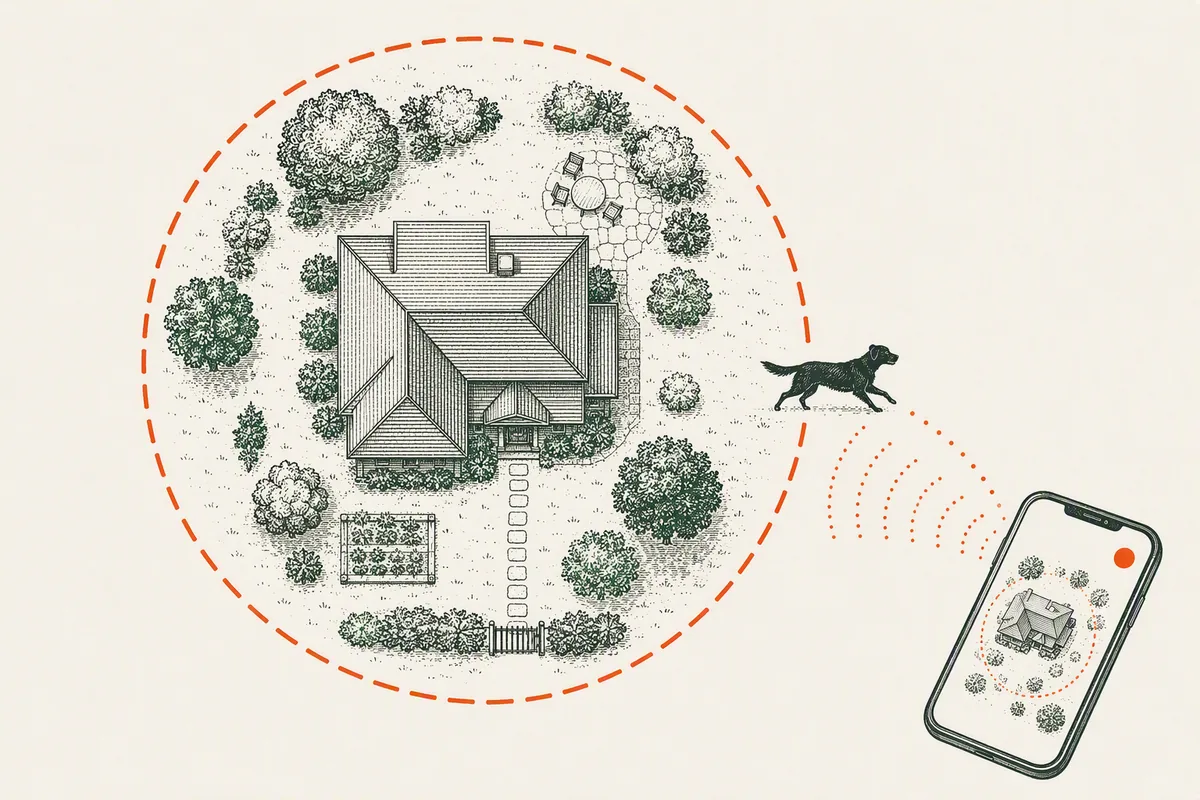
Found your dog? Close the loop
Unwind the machine you switched on. Mark the dog reunited on DogLost, clear the lost flag on the microchip database, tell the dog warden, and take the posters down before they train your neighbours to ignore the next one. Book a vet check even if the dog looks fine: pads, ticks, dehydration and weight loss hide under relief.
Then fix the exit. Most lost dogs are lost the same way twice, whether that is a gap in the fence, a startle point on a walk or a recall that fades around wildlife. Sorting the cause is cheaper than repeating the search.
Questions owners actually ask
How long will the council keep my dog if it is picked up as a stray?
Under section 149 of the Environmental Protection Act 1990, every council must appoint an officer to deal with strays, and a seized dog is held for seven clear days. After that it can lawfully be rehomed or, in some cases, put to sleep, so ring the warden on day one, not day three.
Can I be fined if my dog's microchip details are out of date?
Yes. The Microchipping of Dogs (England) Regulations 2015 made chipping compulsory from 6 April 2016, and keeping the database record current is part of the law. Fines run up to £500. Rules in Scotland and Wales are similar, and a stale phone number is the commonest reason reunions fail.
What if someone has found my dog and decided to keep it?
The Pet Abduction Act 2024, in force in England and Northern Ireland since 24 August 2024, makes detaining a dog you do not lawfully control a criminal offence carrying up to five years in prison. A finder is expected to return the dog or hand it to the council dog warden.
Should I offer a reward for my lost dog?
Rewards on lost dog posters attract scammers as reliably as helpers. If you offer one, never state the amount, never pay anything before you are physically holding your dog, and treat any demand for money before the dog is released as extortion: hang up and report it to the police on 101.
Will a GPS tracker find my dog for me?
A GPS tracker such as the Tractive DOG 6 or Pawfit 3s gives you a live position anywhere with mobile signal, which turns a search into a journey. It does not recall the dog: you still need the calm, no chase approach described above once you get close.