Learn
How do dog GPS trackers work?
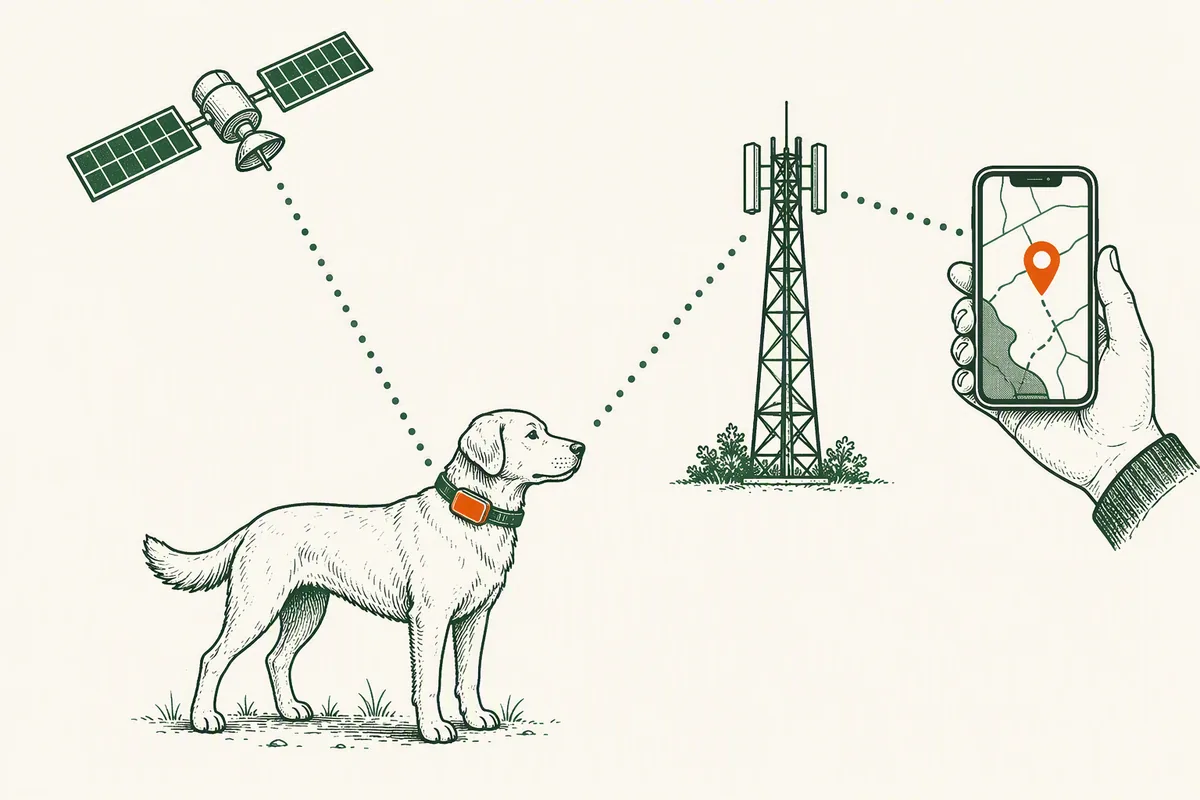
A dog GPS tracker is two radios in one small box. The first listens to navigation satellites and works out where your dog is. The second, a mobile phone chip in miniature, sends that position to the app on your phone. Once you see that split, everything else about these devices makes sense: why they need subscriptions, why they struggle in dense woodland, and why an AirTag is not really a GPS tracker at all. One thing a tracker never does is replace your dog's microchip or ID tag, both of which UK law still requires.
GPS does the finding: how the collar knows where it is
Every dog GPS tracker contains a small receiver tuned to navigation satellites. The original constellation is GPS, run by the US government, but most modern trackers also listen to Europe's Galileo and Russia's GLONASS, which is why spec sheets often say GNSS rather than GPS.
Each satellite constantly broadcasts a signal that says, in effect, here is who I am and here is the precise time I sent this. Radio waves travel at a fixed speed, so the tracker can turn the tiny delay in each signal into a distance. With distances from at least four satellites, it calculates where on Earth it must be, usually to within a few metres under open sky.
Two details matter for dog owners. First, the collar only listens. It sends nothing up to the satellites, and the signals are free to use, so the satellite side of tracking costs nothing. Second, those signals are faint after travelling roughly 20,000 km from orbit, so accuracy drops indoors, in dense woodland and between tall buildings. That is physics rather than a fault with your tracker, and it applies to every brand we have put on a dog.
Cellular does the telling: how the position reaches your phone
Knowing its position is useless unless the collar can tell you. That is the second radio's job: a miniature mobile phone chip with its own SIM card, which sends the position to the tracker company's servers over the mobile network, and from there to the app on your phone.
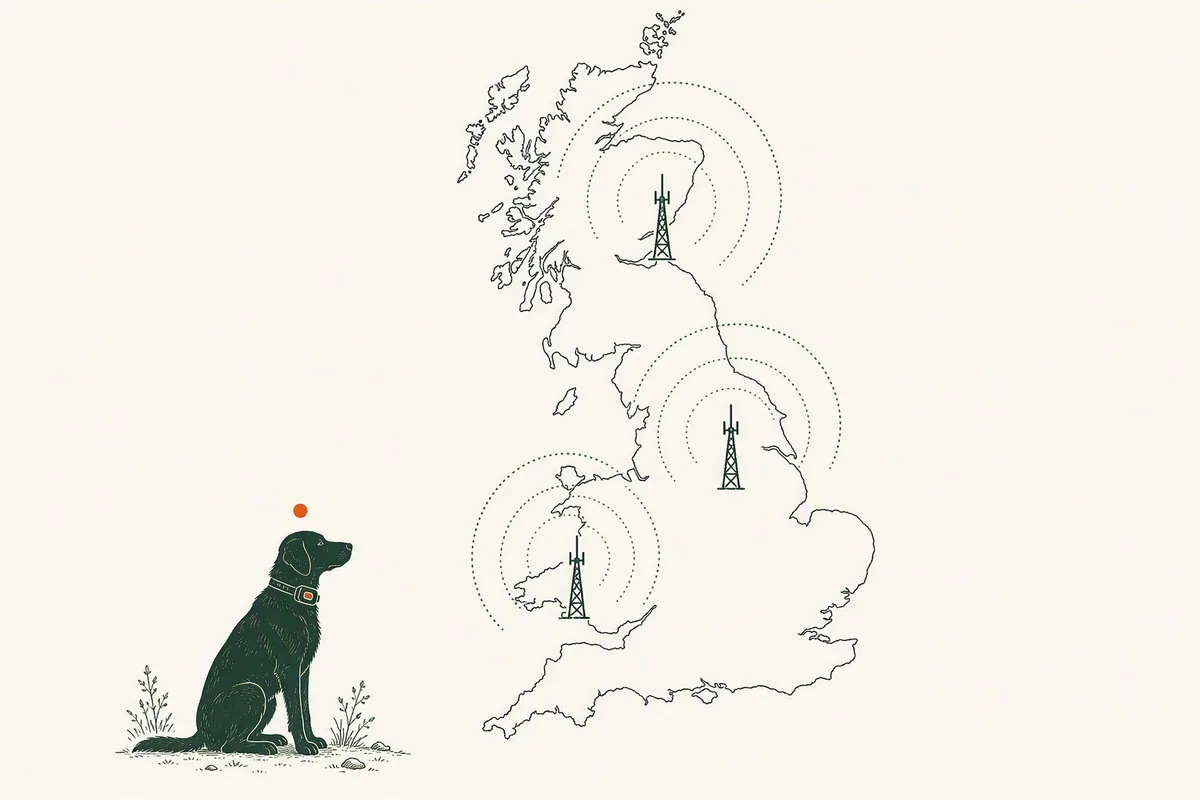
This is the part people miss when they ask why a tracker needs a monthly plan. The satellite signal is free, but every location update is a small packet of mobile data, and the SIM inside the collar has to be paid for like the one in your pocket. Most dog trackers roam across several UK networks rather than relying on a single one, which helps in rural areas where one operator has coverage and another does not.
It also explains the technology's main weakness. In a mobile blackspot the collar still knows exactly where it is, it just cannot tell you. Most models keep logging positions and upload the stored trail once signal returns, and the app shows the last known location in the meantime. Live mode, where updates arrive every few seconds, works this radio hardest, which is why it also drains the battery fastest.
The four technologies, compared
Four different technologies get attached to the word tracker, and they behave very differently on the day a dog actually goes missing.
| Technology | How it works | Coverage | Live tracking | Ongoing cost |
|---|---|---|---|---|
| GPS (satellites) | Collar receives timing signals from navigation satellites and calculates its own position | Worldwide outdoors; weak indoors and under dense cover | Yes, once paired with a transmitter | None for the satellite signal itself |
| Cellular | A built-in SIM sends the GPS position to your phone over the mobile network | Anywhere with mobile signal | Yes | Subscription or prepaid plan |
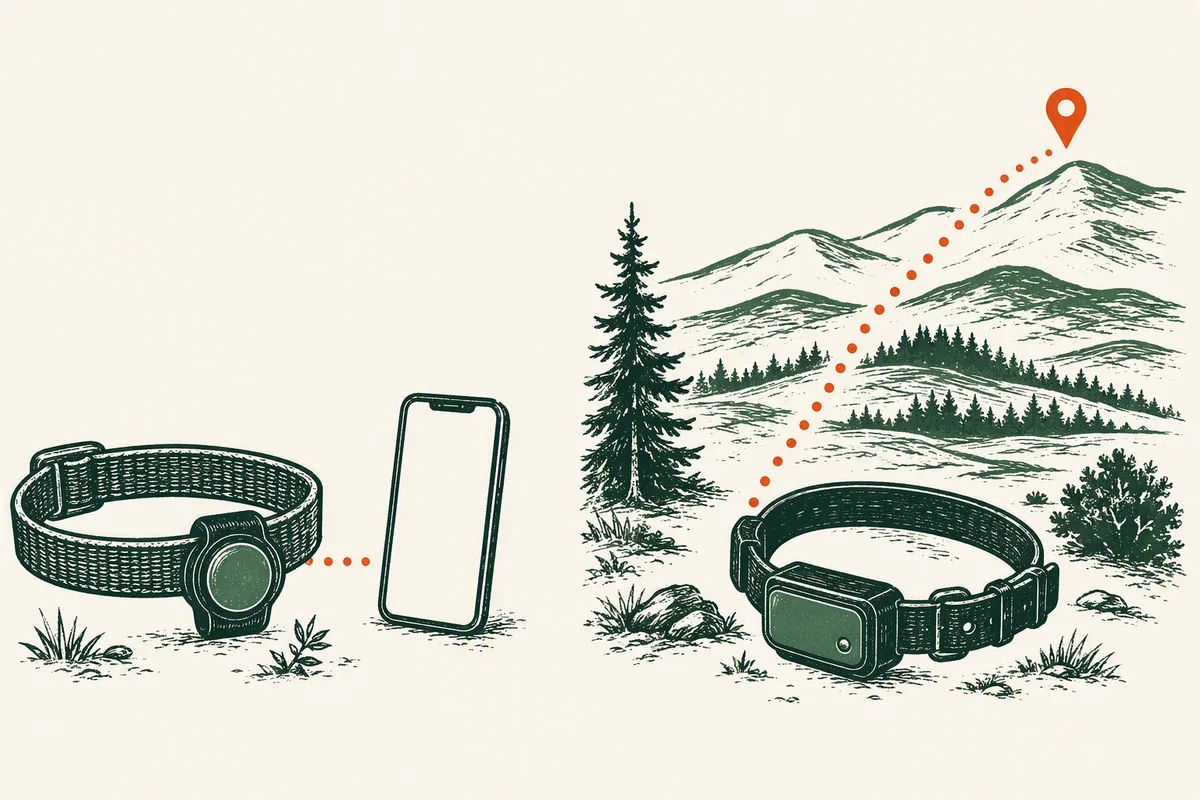
| Bluetooth (AirTag type) | Tag broadcasts a short-range signal and passing phones relay its location | Good in busy towns; patchy to non-existent in the countryside | No, updates only when a device passes | None |
| Radio frequency (RF) | Handheld receiver picks up the collar's radio signal and points you towards it | Line of sight between handset and collar | Direction and rough distance, no map | None |
The four technologies used to locate dogs. Only GPS combined with cellular gives a live position on a map anywhere with mobile coverage.
Bluetooth trackers such as Apple's AirTag contain no GPS at all. The tag broadcasts a Bluetooth signal, and any passing iPhone quietly relays the tag's whereabouts to Apple's Find My network using the phone's own location. In a busy town that works surprisingly well, because there is nearly always an iPhone within range. In a field, a wood or a quiet village at night there may be nobody to relay the signal, so the map can sit frozen for hours, precisely when you need it most. There is no live tracking, and Apple designed the AirTag for keys and luggage rather than animals.
RF trackers are the old gamekeeper's tool. The collar transmits a radio signal, and a handheld receiver tells you which direction it is coming from and roughly how far away it is. No network, no SIM, no subscription, and they keep working in places phones do not. The trade-offs are line-of-sight range, no map, and the fact that you must be out there sweeping the receiver yourself.
Do dog GPS trackers need a subscription?
GPS and cellular trackers do, almost without exception. The subscription is not an optional extra bolted on for profit alone: it pays for the SIM in the collar, the mobile data every update consumes and the servers that push positions to your app. We break down what the plans add up to over a dog's lifetime in our tracker cost guide.
If a monthly fee is a dealbreaker, there are three routes. Bluetooth trackers are subscription-free but offer no live tracking. RF systems are subscription-free but need you within radio range. And a small group of GPS trackers bundle the connectivity into the purchase price instead of a rolling plan; we compare those in our guide to the best no-subscription dog trackers.
Microchip vs GPS tracker: different jobs, both needed
This causes real confusion, so let us be blunt: a microchip cannot track your dog. It is a passive RFID capsule about the size of a grain of rice, with no battery, no GPS and no transmitter. It does nothing at all until a vet or rescue centre holds a scanner a few centimetres away, at which point it reveals a unique number linked to your details on a database. If your dog is lost, the chip only helps after someone has already caught the dog and taken it to be scanned.
It is also the legal baseline. Microchipping has been compulsory for dogs in England, Scotland and Wales since 6 April 2016, with chips required by the time a puppy is eight weeks old, and it has been required in Northern Ireland since 2012 through dog licensing. The law only counts your dog as microchipped if the chip is implanted and your current details are registered on an approved database. If you are served notice and fail to comply within 21 days, you face a fine of up to £500.
So it is not really microchip versus GPS tracker. The chip is the legal minimum that identifies a found dog; the tracker is the optional tool that helps you find the dog in the first place. If the worst happens, our guide to finding a lost dog covers what to do hour by hour.
Do dogs still need an ID tag with a GPS tracker?
Yes. Under the Control of Dogs Order 1992, a dog in a highway or place of public resort must wear a collar with the owner's name and address on it, either inscribed on the collar itself or on a plate or badge attached to it. Breaking the rule is an offence under the Animal Health Act 1981 and can end in a fine. There are exemptions, mainly for working dogs: packs of hounds, dogs driving cattle or sheep, police and armed forces dogs, and registered guide dogs among them.
A GPS tracker does not satisfy this law, and neither does a microchip. Nobody who finds your dog can read either without equipment, whereas a tag can be read by anyone. In practice the three layers work together: the tag lets a friendly finder phone you, the chip identifies the dog at a vet or shelter, and the tracker often gets you to the dog before either is needed. Most trackers clip alongside a tag on the same collar without any trouble.
Which technology should your dog wear?
For most UK owners the practical answer is a GPS and cellular tracker on the collar, a tag that meets the 1992 Order, and an up-to-date microchip record behind both. City dwellers with secure gardens may get by with a Bluetooth tag as a cheap backup, and handlers working dogs far beyond mobile coverage still have good reason to look at RF.
If you want to see how the GPS models compare on real dogs, start with our rankings of the best dog GPS trackers, and read how we test to see what will sit behind the scores.
Questions owners actually ask
Do dog GPS trackers work without mobile signal?
Partly. The collar still receives satellite signals and knows exactly where it is, but without mobile coverage it cannot send that position to your phone. Most trackers show the last known location and upload the stored trail once signal returns.
Can I use an AirTag as a dog GPS tracker?
Not as a live tracker. An AirTag has no GPS of its own; it relies on passing Apple devices to relay its position, so updates can stop entirely in rural areas. It makes a reasonable backup in town, but Apple designed it for belongings, not pets.
Does a GPS tracker replace the microchip or ID tag?
No. UK law requires the microchip regardless, and the Control of Dogs Order 1992 requires a collar with your name and address on it in public, whatever else the dog wears. A tracker is an extra layer, not a substitute for either.
Why does a tracker need charging when a microchip never does?
A microchip is passive: the scanner powers it for the split second it is read. A tracker runs a satellite receiver and a cellular radio all day, and that constant work is what the battery is paying for.